
 By
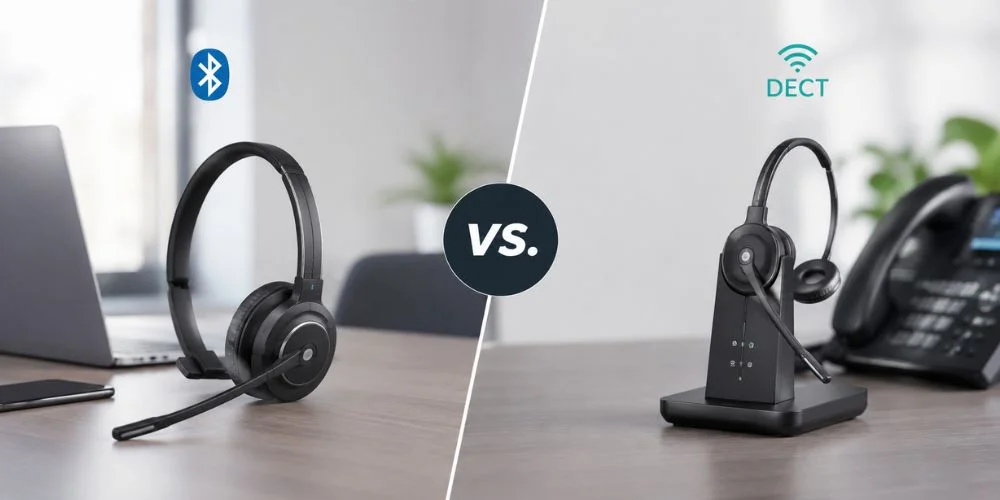
By While searching for the best wireless headsets online, you’ll come across two terms: Bluetooth and DECT technology.
Although both of them provide wireless connections, the way they work and the purpose of both types of headsets are entirely different.
In this blog, we’ll walk you through everything that points out the difference between these two different types of wireless headsets. At the end, you’ll be able to decide which one to choose.
What Is a Bluetooth Wireless Headset?
It is a wireless technology that allows devices to connect over short distances. It is commonly used in smartphones, tablets, laptops, and other personal devices.
A bluetooth wireless headset can pair directly with multiple devices. It does not require any dedicated base station in many cases. This makes it a popular choice for mobile professionals and remote workers.
What Is a DECT Wireless Headset?
DECT stands for Digital Enhanced Cordless Telecommunications. This technology is most particularly designed for voice communication.
In contrast to Bluetooth, DECT wireless headsets actually connect through a dedicated base station that links to desk phones, computers, or communication systems.
Difference Between Bluetooth and DECT Headsets
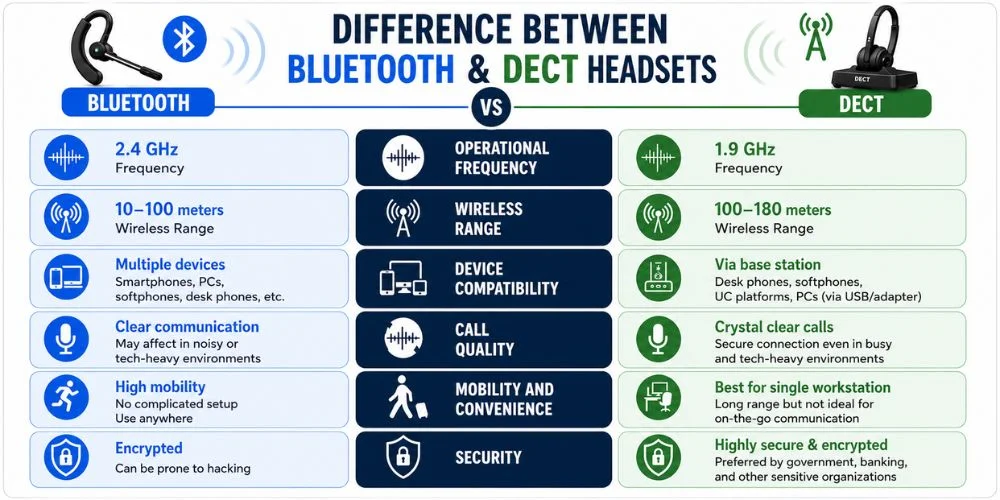
Both of these technologies have to offer some special features. The wireless headset guide will explain the major differences between Bluetooth Vs. DECT models. The details have been mentioned below.
Operational Frequency
The Bluetooth headsets operate at a frequency of about 2.4 GHz. Whereas a DECT headset operates at the frequency of 1.9 GHz. This specific band allows these headsets to have a stable and secure connection. Whereas the Bluetooth connection may get disrupted due to nearby devices.
Wireless Range
The Bluetooth headsets have a wireless range of about 10-100 meters. This means you can move around in the house and office space without any worry about signal loss. However, the DECT headsets have a broad wireless range. The signal stays stable at 100 m and can even last up to 180 meters.
It is important to note that the walls and interference can affect the range. The Bluetooth ones may have more distortion compared to the DECT headsets.
Device Compatibility
Bluetooth headsets can connect to multiple devices at a single time. Their compatibility extends to smartphones, PCs, softphones, desk phones, and other devices.
The DECT headsets usually connect through the base station, and they work well with desk phones, softphones, and UC platforms. With the help of a USB or adapter, these headsets can also connect to PCs.
Call Quality
Both these technologies lead to clear communication. But if there is a noisy crowd with lots of telecom devices nearby, then it can affect the call quality through a Bluetooth headset.
But when it comes to DECT technology, it is a more secure connection. So even in a busy and tech-heavy environment, the calls stay crystal clear.
Mobility and Convenience
As Bluetooth headsets do not require any complicated setup for connection, so you can use them anywhere you want. They are suitable for remote professionals or travel workers who have to move between spaces and locations.
On the other hand, the DECT headsets are more suitable for a single workstation. They do offer long range, but they may not be suitable for people who want on-the-go communication.
Security
For government, banking, and other sensitive organizations, security matters a lot. The Bluetooth connection is encrypted, but it can still become prone to hacking.
However, the DECT technology provides much more secure and encrypted communication. That's why professional organizations prefer such headsets.
Bluetooth Vs. DECT Headsets Comparison
Here is the quick difference between Bluetooth and DECT headsets in a nutshell:
| Feature | Bluetooth Headsets | DECT Headsets |
|---|---|---|
| Connection Type | Directly to Mobile Devices | To a Base Station |
| Wireless Range | Short Range (10-100 m) | Long Range (100-180 m) |
| Frequency Band | Crowded 2.4 GHz Band | Dedicated 1.9 GHz Band |
| Interference | High Risk from Wi-Fi | Virtually No Interference Risk |
| Device Pairing | Multiple Mobile Devices Simultaneously | Typically Through the Base Station |
| Security Level | Standard Encryption Protocols | Enhanced Security and Encryption |
| Battery Life | Shorter Talk Times Overall | Longer Continuous Talk Times |
| Compatibility | Universally Supports Mobile Devices and Laptops | Desk Phones and PCs |
| Best For | On-the-Go Hybrid Workers | Fixed Desk Call Centers |
DECT Vs. Bluetooth Headset: Which One Should You Choose
The choice depends upon your professional activity and work style. If you are a remote or hybrid worker who needs flexible headsets, then Bluetooth is the better option. However, if you work in a busy office environment where your main activity is communication or calls, then it is better to go for DECT headsets.
The affordability matters too. DECT headsets are priced higher than the Bluetooth ones. So, a sensitive organization should definitely invest in the former ones. However, general office workers can consider the latter option to get quality features at an affordable price range.
The major brands that offer these headsets include Jabra, Poly (Plantronics), and Yealink. You can consider these brands for purchase.
Conclusion
Bluetooth headsets come with multiple connectivity options and greater freedom of movement. The DECT headsets provide stable and secure communication over long distances in an office environment. The final choice depends on your work style and activity. If you need more info regarding these headsets, you can get in touch with Find Headsets for full support.
No comments yet. Be the first to comment!
Leave a ReplyYour email address will not be published. Required fields are marked *