
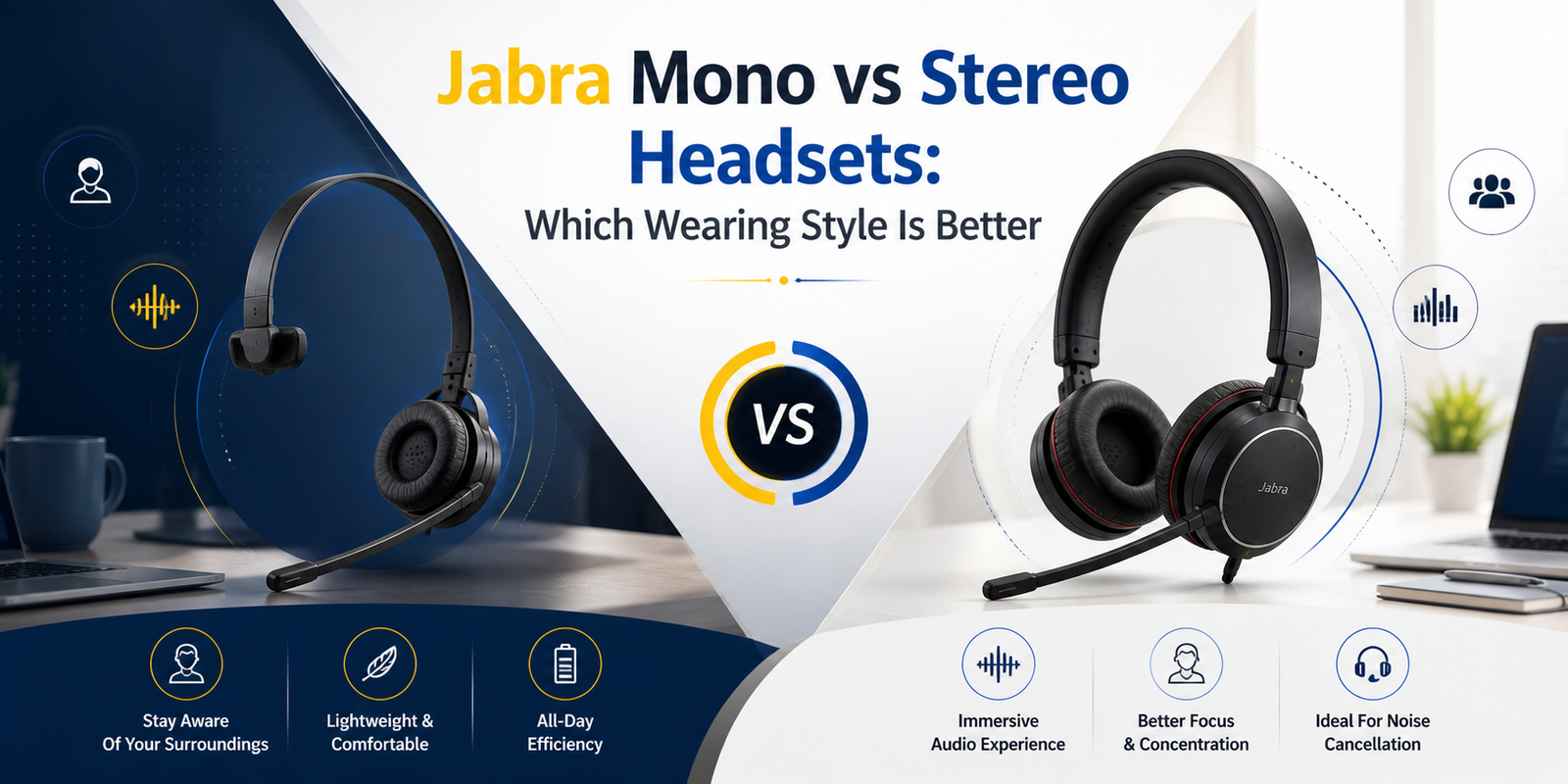
The Jabra brand is a popular choice for professional headsets, and there are several models suitable for use in the workplace, call centers, and customer service environments, as well as those used by remote workers. However, an important initial question to ask when picking a headset is "one or two ears?
This is where mono and stereo listening styles differ. A mono headset is designed to fit over one ear whilst a stereo headset fits on both ears. The gap makes a big difference when talking to others, when you want to concentrate on your work, and when you're wearing the headset for a long shift.
To others, workplace knowledge is more important. Others seek to minimize distractions and concentrate on the conversation. So you can choose based on your activities and your comfort level, as well as your working environment.
This article will explore the pros and cons of Jabra mono vs stereo headsets, and examine the different types of work settings where they might be more applicable.
What Is a Mono Headset?
A mono headset is a headset fitted with a single earpiece, to be worn over one ear. The other ear is not covered and you can hear what's going on around you with the headset.
This is a common design in formal communication as people can get calls without isolation from the rest of the world.
How a Mono Headset Works
Audio is played via a single speaker and your voice is recorded via a microphone when you make a call. An open ear designed for natural hearing in the workspace environment.
For example, a person who speaks with you on the phone, a person who walks to your desk or one who calls to your desk without removing the headset.
Common Use Cases for Mono Headsets
Mono models can be beneficial to receptionists, customer service representatives, supervisors or workers who need to switch between phone calls and face-to-face meetings regularly.
These are particularly useful when communicating with others in the immediate vicinity is an everyday part of your job.
What Is a Stereo Headset?
A stereo headset is a type of headset that has two 'ears'—one for each ear. This configuration can provide music output on both sides, as well as provide more of a private listening experience.
For professional model users, there are stereo models in both the Evolve and Evolve2 series, reflecting the popularity of this style when it comes to meetings, working and communicating in busy areas.
How a Stereo Headset Works
Both speakers are contained within the same casing and provide INCOMING audio – this makes it more enjoyable to listen to than a SINGLE EAR design.
In addition, the physical coverage helps to minimize the noise from outside. This can assist focus during discussions or when working closely with others.
Common Use Cases for Stereo Headsets
Stereo headsets may be appropriate for professionals who spend a significant portion of their workday on the phone, on a computer, in virtual meetings, training sessions and webinars.
They may also be utilized in co-working spaces where the noise of other people around you may cause some problems focusing.
Jabra Mono vs Stereo: Detailed Comparison
The basic designs are useful, but they'll make a difference when you know how each style will work in a real work situation.
Sound Quality
A stereo headset will usually result in richer audio which is available to both ears. This may be beneficial for meetings, training, presentations and other content where detailed sound is important.
There are voice communication applications that are more specific to mono models. They can carry clear speech in every call without closing down a hearing area, thus maintaining human presence. They're not sensitive to a fully enclosed listening space and can send clear speech for normal calls.
Comfort During Long Shifts
Depending on the model, wearing configuration can mean the difference in comfort over a long period of time.
The mono headset will show up in one ear; some people find that to be cooler and less restrictive. Stereo models are designed to fit into both ears and will distribute the mass of the headset.
Ultimately, the best headset will be the one you find most comfortable, with the right weight, padding and fit, after extended wear.
Awareness of Surroundings
One of the most apparent differences between the two setups is this.
With a mono headset, one ear remains open, allowing you to hear close conversations and activity in the workplace.
A stereo headset will provide greater noise isolation from the environment. This can be helpful if it's important to be able to focus on a single thing, rather than everything around you.
Background Noise Handling
External noise can definitely be captured by at least part of the stereo models as the ears are covered.
This can be useful in open-plan offices or hectic call centers where several calls are ongoing simultaneously.
However, in mono models, more ambiance is allowed through, and in most cases, with a bit of help from mic technology the background noise won't affect the person on the other end of the call.
Wearing Fatigue Over Time
However, there are lots of things that influence long term comfort and the mono/stereo design of the headset isn't one of them.
After a few hours, the comfort of the headset can be affected by the pressure exerted by the headband, the material used for the ear cushions, the weight of the headset, and the fitability of the headset and ear cushions.
Some people like mono mode as one side of their ear is free, whereas some people like stereo mode as it feels well balanced and has less pressure and weight.
Price and Value
Some modes of wearing a Jabra headset aren't automatically related to the price of the headset.
This can raise the effect on costs due to elements such as microphones, wireless, battery, charging, and professional certifications, among others that are part of “active noise cancellation.”
This means you'll need to make a comparison of the total features and not assume that all clothing will cost you a lot to put on.
Mono vs Stereo Headsets: Pros and Cons
Each set up has advantages and disadvantages.
Advantages of Mono Headsets
Mono headsets can be handy for individuals who want to be aware of what is going on around them. They may also help to communicate with individuals in the immediate vicinity without the use of the headset.
These types of single ear headphones are good for people who don't want to have both ears covered for the entire day.
Limitations of Mono Headsets
The open-ear design makes it possible for you to hear more of your environment. This could prove to be distracting in a busy office.
In general, they aren't as they are designed primarily for a more immersive listening experience, or to be farthest from other people's conversations.
Advantages of Stereo Headsets
A stereo headset provides sound to both ears and is best for concentration.
They can also be helpful for distraction control when the environment is noisy, meetings, training sessions and for long conversations, as well as for multimedia.
Limitations of Stereo Headsets
Covering their ears diminishes their awareness of what is going on around them. This might not be suitable for reception or positions where you have to interact with others a lot.
Note that in extended durations some of the users may feel more warmth and pressure in the ears.
How to Decide Based on Your Job Role
If you're going with either of these styles, it's more important than your role.
Customer Support and Call Centers
For agents who have to interact with coworkers or supervisors on a regular basis on the job, mono is a good option.
Noise cancelling earbuds might be more suitable if the agents work in a noisy environment and need to concentrate on the conversations with customers.
Reception and Front Desk
Mono is typically easier for reception personnel who must listen to visitors, co-workers, phones and other activities when taking calls.
Having one ear open helps them to stay available without having to repeatedly take the headset off and put it back on.
Remote and Hybrid Workers
Employees who have a lot of virtual meetings or computer intensive work time can benefit from stereo.
In cases where the user operates in a common environment and must be conscious of others around him, a mono configuration might be more appropriate.
Training and Meeting-Heavy Roles
Stereo may be a better choice for you if you are someone who is doing a lot of webinars, presentations, training, or extended online meetings.
When listening to audio, the two ear setup is more suitable for the listener.
Are Mono or Stereo Headsets Better for Open Office Environments?
It can be more complex when you're in an open office, where people must balance concentration and communication and need to consider a headset.
Where there is a lot of talking in the workspace, and you want to be there for your team, mono may be a great option.
When it comes to talking on the phone or meeting in a noisy environment, stereo can provide greater separation from other distracting noises.
It will depend on whether you have to interact with others at all times or pay full attention at all times.
What Makes a Headset Comfortable for Long Hours?
However, other elements beyond the wearing style are important for long-term comfort. There are some physical attributes to be taken into account prior to purchase.
Weight and Headband Pressure
For a full day's wear, it may be easier to wear a lightweight headset with the right pressure on the headband.
Over time, too much pressure can become apparent, particularly when you are wearing the headset all of the time.
Ear Cushion Material
Cushioning and softness can be enhanced with well-designed cushions.
The quality of the cushion is especially important for stereo models as both ears are covered for a longer period of time.
Adjustable Fit
The headset should be adjustable to ensure the earpiece and headband are comfortable.
Adjustability allows for different head sizes and minimizes the likelihood of pressure building up in any one area.
Heat and Ear Coverage
It may be preferable for users working in warm environments to use an open-ear mono version.
Stereo models offer more coverage, which may be helpful for focus, but also may be warmer over longer periods of time.
Top Jabra Mono Headsets to Consider
Jabra Engage 50 II Mono Headset
The Jabra Engage 50 II Mono Headset is a professional headset, suitable for call centers and busy offices, that is wired.
Uses several microphones and digital signal processing to enhance voice communication and to minimize unwanted background noise. The Engage Link controller also contains easy-to-use controls to operate a variety of features such as volume, mute and calls.
Best suited for: Call Center Agents and Professionals who prefer to communicate clearly and be aware.
Pros:
- Multi-mic setup with pro-sounding qualities.
- Easy to use Engage Link controls
- Lightweight single-ear configuration
- Can be used in the workplace for the long term.
Cons:
- Wired = not mobile.
- The film is more appropriate for communication than entertainment.
Jabra Biz 1500 Duo Wired Headset
The Jabra Biz 1500 Duo Wired Headset is a two-ear headset for professional desk-based communications.
It is also wired which means that it doesn't need batteries to charge or Bluetooth to pair with Bluetooth-enabled devices, thus extending battery life and saving situations where steady wireless connectivity is essential, such as a fixed workstation.
Best suited for: Simple wired connection for basic business communications.
Pros:
- Stable wired connection
- No charging requirement
- Design in everyday office applications.
- Perfect for office telephony.
Cons:
- Cable restricts movement
- The advanced options are not as many as those on the high-end models.
Top Jabra Stereo Headsets to Consider
Jabra Evolve 65 Te Stereo Wireless Headset
The Jabra Evolve 65 Te Stereo Wireless Headset offers wireless convenience and dual ear headphones.
It is ideal for hybrid workers who are involved in business communication and virtual meetings, or using audio in general.
Perfect for: Workers who use their headset both for work and at home.
Pros:
- Wireless mobility
- Two-ear listening experience
- Meets the requirements for meetings and general audio.
- Flexible for hybrid working.
Cons:
- Requires battery charging
- Calms down to other people's actions nearby
Jabra Engage 65 Stereo Wireless Headset
The Jabra Engage 65 Stereo Wireless Headset is designed for the professional environment where mobility and communication are all-important.
It's stereo, which means it is perfect for those who need to take or receive phone calls for an extended time and prefer to have both ears covered.
Ideal for: Professionals who need to be free to move around while at work.
Pros:
- Wireless workplace mobility
- Clear professional audio
- Specially engineered for everyday business use.
- Using two ears to listen
Cons:
- Higher priced than standard wired units
- Less environmental awareness
Jabra Evolve2 85 Headset
The Jabra Evolve2 85 Headset is one of the best over-the-ear headsets and is ideal for professionals who require concentration.
It offers noise cancellation features and is over-the-ear, making it ideal for intense meetings, training and computer work sessions.
Perfect for: Users who need a high end solution for intensive work purposes, and for extended online meetings.
Pros:
- Advanced noise reduction
- Over-ear construction
- Premium listening experience
- Designed specifically for the targeted application by professionals.
Cons:
- Higher cost
- Larger design could feel heavier if it is a very lengthy session.
Jabra Mono and Stereo Options at a Glance
| Model | Style | Connection | Suitable For |
|---|---|---|---|
| Jabra Engage 50 II Mono | Mono | Wired | Call centers and shared offices |
| Jabra Biz 1500 Duo | Stereo | Wired | Desk-based professional calls |
| Jabra Evolve 65 Te Stereo | Stereo | Wireless | Hybrid work and meetings |
| Jabra Engage 65 Stereo | Stereo | Wireless | Extended professional calls |
| Jabra Evolve2 85 | Stereo | Wireless | Focused work and meetings |
What Should You Consider Besides Mono or Stereo?
The earpiece design shouldn't be your only consideration when purchasing.
Microphone Quality
When communicating with a business, you need to be able to hear the other person.
Describe the importance of a microphone that has noise management features for ensuring speech intelligibility in the workplace.
Connectivity
Think about the way you'll plug in the headset to the device.
There are various options including USB, Bluetooth, DECT or other professional connections.
Compatibility
See if the headset will work with your devices and communication platforms.
This can be a computer, desk phones, smart phones, Microsoft Teams or other unified communications platforms.
Wireless Mobility
If you're on the go all day long from your desk, or you're not, wireless connectivity may be more important than mono vs. stereo.
Consider the activities you will be able to do in the workplace throughout the day.
Battery Life
Please be aware of talk time and charging requirements for wireless users.
Comfort is the most important thing to consider when using a headset, but it will get tedious if it doesn't last through the typical workflow.
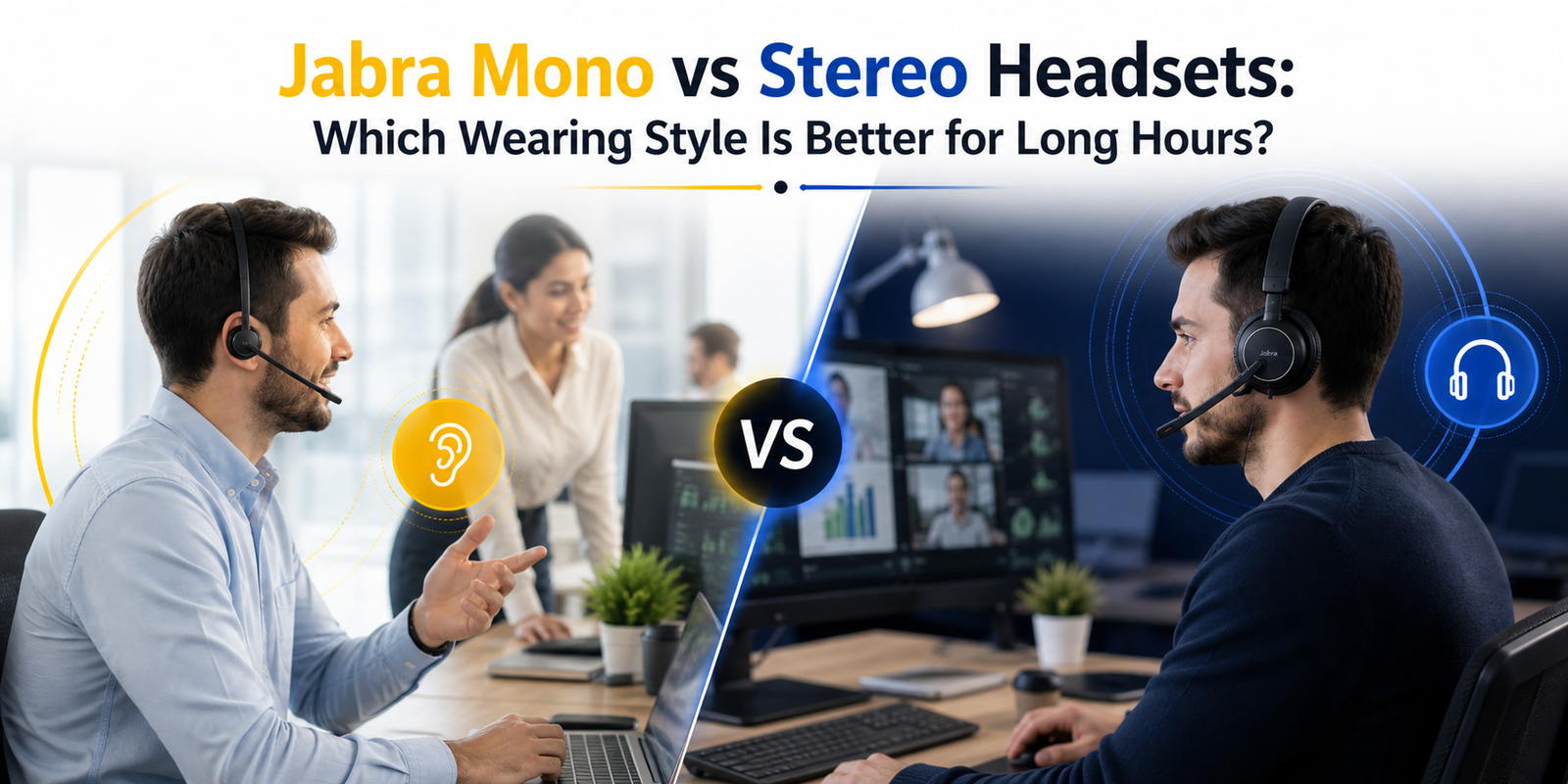
Jabra Mono vs Stereo Headsets: Which Wearing Style Is Better for Long Hours?
It will depend on your work environment and activities if you have to wear a headset for extended periods of the day.
A mono headset will be more suitable if you are looking to communicate with nearby people while keeping connectivity for calls as well. Ideal for roles in reception, customer service and shared offices, particularly in the role of reception, reception/co-ordination and reception office.
If you're just concentrating on your work, then a stereo headset is generally preferable. When you cover both ears, you can eliminate distractions and provide a focused listening environment for meetings, training and extended conversation.
Comfort should also be taken into consideration. Heavy weight, pressure on the head, ear cushions, adjustability and overall fit all contribute to the headset being either a great part of the day or a bad part of it.
Use mono if a need for awareness is present. Play in stereo to concentrate.
For instance, some Jabra families, such as the Jabra Engage Series Headsets, have various wearing options to give businesses flexibility in choosing headsets for various individuals and roles.
Does Wearing Style Affect Microphone Performance?
The more earpieces you have, the better-sounding headset microphone, it's not necessarily. The clarity of the voice depends more on the microphone system, the noise filtering, positioning of the microphone and the digital processing of the digital system of a particular model.
How Microphone Placement Differs
Boom microphones can be used with either a mono or stereo headset. The result is that the microphone can capture speech much more clearly and sounds from a further distance will have less effect.
Just because a hat is worn does not mean that it is better for voice transmission. When comparing one Jabra to another, check the technology of the microphone, rather than ear coverage.
Why Background Noise Still Matters
The context in which you live can have a powerful impact on your sound. Conversations, keyboards and office machinery can generate unwanted noise as can nearby calls.
Designed properly, a professional headset may have more than one microphone and digital signal processing to aid in the separation of voices from other background noise. This is especially useful in call centers and open-plan offices where it is hard to eliminate background noise.
Therefore, when choosing a Jabra headset, users should also take into account the properties of the microphone and noise management when wearing the headset if they are working in a noisy environment.
Does Mono or Stereo Affect Hearing Protection?
No. The design (mono or stereo) doesn't directly equal the level of hearing protection a Jabra headset offers. Protection will vary according to the technology of the model, such as either PeakStop, SafeTone, SafeTone 2.0 or G616.
The features may enable it to control unwanted or loud noise levels, and offer a more pleasant calling experience for customers who wear the headset for long periods of time. However, Jabra does not provide the same protection with each model, so it's best to check the headset you are looking for.
Not to mention, Jabra Hearing Protection Features Explained for Professional Users gives you a good idea of the difference between these technologies and what to expect if you're thinking about purchasing a headset for extended periods of time.
Buy Jabra Headsets With Expert Support and Warranty Coverage
Mono and stereo are all that's relevant, though. Other factors to consider include compatibility with your device, connection type, calling platform and workday.
At Find Headsets, users can see and compare a selection of Jabra headsets which are tailored for professional communication such as the Biz, Engage, Evolve and Evolve2 families.
Consult our customer support team for a comparison of suitable options if you are not sure which one would best suit your needs based on your working environment, device, preferred connection and wearing style.
Technical support and compatibility data are also available to help you make your selection before buying.
The warranty requirements may vary according to the product; it is always better to check the particulars of the product to see what the warranty is for that product.
You've been wondering which one is the best between the Jabra mono and stereo headset? The FindHeadset team is here 24/7 to assist you in choosing the right one. Let us know about your workspace, setup and any specific requirements and we will suggest a headset for you that is suited to your comfort, work style, and audio needs.
Conclusion
Whether you're more of a Jabra mono vs stereo headset fan depends on your preferences.
The mono can be helpful if you have to listen to other activities in the environment such as colleagues or visitors. Stereo is better if you need to focus on music and there are not a lot of other noises around.
However, do not expect to get a good idea of a headset by its appearance. The feel, size, padding, microphone quality, connectivity and other characteristics can be as important as the gram weight.
The ideal headset is thus the one which fits the job, location, listening requirement, and use time of the day.
Compare professional mono and stereo options for various work needs with Jabra Headsets.
Frequently Asked Questions
Is a Mono or Stereo Headset Better for Phone Calls?
These are all viable business calls to make. For awareness of the surroundings: use MONO; for focusing your listening: use STEREO.
Do Mono Headsets Have Lower Sound Quality Than Stereo?
Mono models are generally designed for voice communication (one ear) and stereo models are designed to give a fuller two-ear experience. But the overall call quality is also dependent on the headset's speakers and audio technology.
Which Wearing Style Is Better for Long Working Hours?
There's no one right solution. One ear is uncovered with mono, which may be less restricting, and stereo offers better concentration. Pressure of fit, weight and padding of the headband are also essential.
Can I Hear My Surroundings With a Stereo Headset?
Some environmental sounds can still be heard, but this competition is to be heard with both ears, which reduces the awareness here, compared with a single ear design.
Can I Get Mono and Stereo Options From the Same Jabra Series?
Yes. Some Jabra professional ranges offer various different wearing options, enabling businesses to choose the right look for the right person without having to switch to a different product family.
Are Stereo Headsets Always Better Than Mono Headsets?
No. Stereo is helpful in contexts where concentrated listening is required, and mono in contexts where awareness and interaction with nearby persons is important.
Does a Mono Headset Cause Less Ear Fatigue?
For some people, it may be less confining since one ear is left uncovered. But fatigue is not related to configuration alone but rather to the weight of the headset, fit, pressure and wearing comfort of each headset.
No comments yet. Be the first to comment!
Leave a ReplyYour email address will not be published. Required fields are marked *