
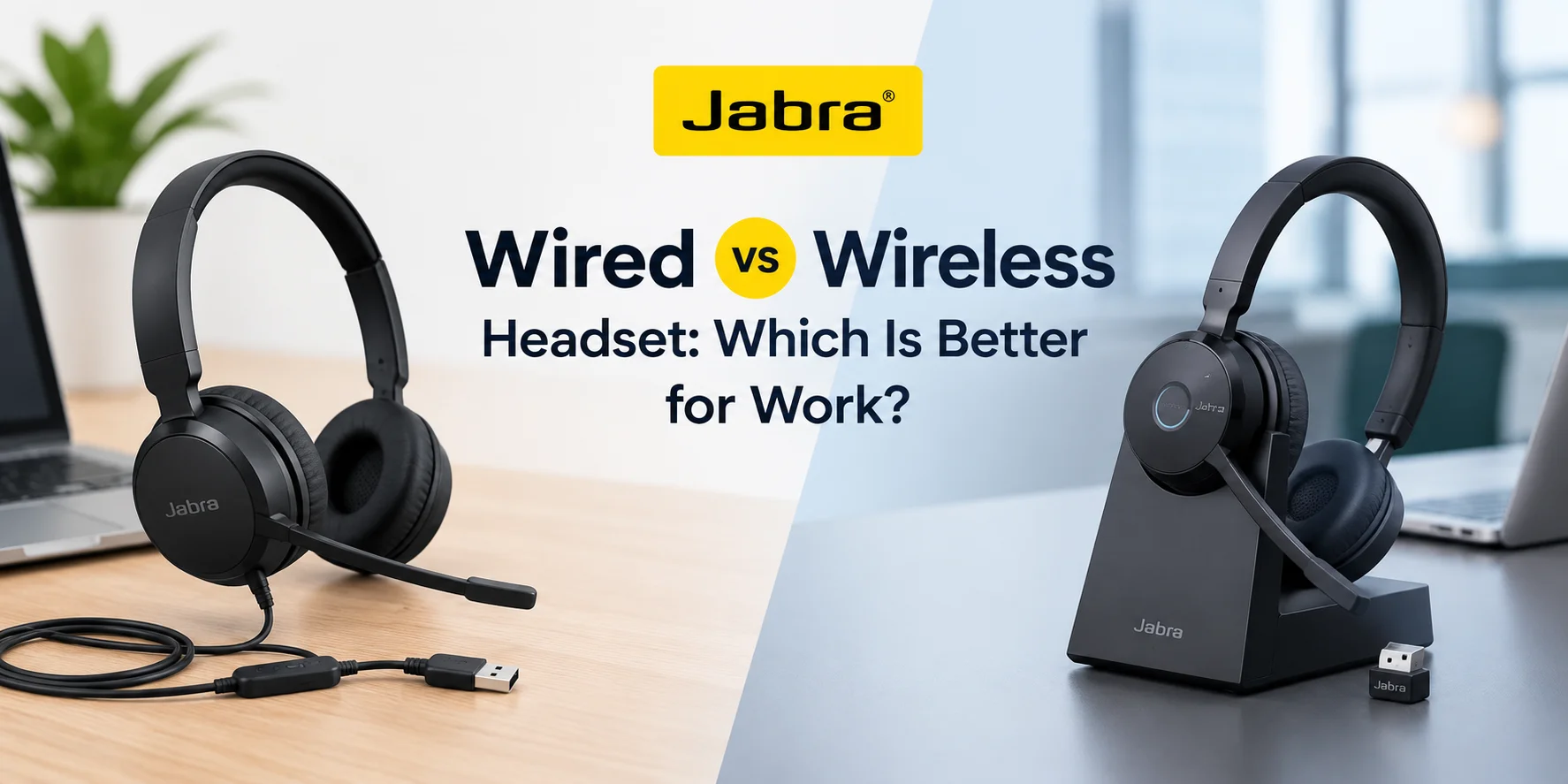
There are numerous Jabra headsets for office use, but the most appropriate one will rely on the way in which you function. Another option is to get a wired Jabra headset if you're at your desk most of the time and don't need wireless capabilities. A wireless headset might be a better option if you frequently change locations or use more than one phone or if you prefer freedom of movement.
The difference between Jabra Wired vs Wireless Headsets is not just about how their headsets are connected. Other factors include comfort, compatibility with the device, time of call, wireless range, and the work environment.
Jabra also offers wired and wireless solutions for different work situations. This guide sets out to explain the major differences and the right headset for the job.
What Is the Difference Between Jabra Wired and Wireless Headsets?
It's all about the way the headset is connected to the device. A wired Jabra headset is plugged into a compatible computer or other supported device using a cable. Doesn't require charging batteries or a wireless signal setup is easy. A Jabra wireless headset is connected to the device without using a cable. It can be Bluetooth or DECT technology, depending on the model.
This disparity can impact the way you wear the headset for your working day. Wired headsets provide no hassle of charging and connecting.
Wireless headsets provide you with more freedom of movement, but you will have to understand how long the battery lasts, how far the wireless signal extends and the kind of wireless connection type. There's no one right answer for all. The correct answer will rely on your job.
Why Choose a Jabra Wired Headset?
A wired headset may be a good option if you are spending most of your time at a desk.
If the same machine is being used throughout the day, extra expenses for wireless mobility may not be needed. A wired headset allows you not to worry about battery charging and also provides a more reliable connection.
Jabra Evolve2 30 SE Stereo for Desk-Based Work
The Jabra Evolve2 30 SE Stereo is a business-oriented wired headset that will work for computer users.
It is a stereo design that covers both ears for calls, online meetings and other computer based communication.
As it isn't wireless or range dependent, it can be a viable option for frequent workers who work mostly at a single desk.
When Is a Wireless Jabra Headset Better?
Where work isn't always conducted at one address, wireless headsets can be more beneficial.
For instance, a manager can have to move to a different office during a phone call. The supervisor may have to navigate a crowded floor without losing track of what's going on. It can also be helpful for a home worker to take a break from the computer during the meeting without terminating it.
In such instances a cable can feel restrictive.
Wireless headsets might be helpful for:
- Managers and supervisors
- Reception staff
- Sales professionals
- Hybrid workers
- People who move between different work areas
- Users who work with multiple compatible devices
The primary justification for opting for wireless should be real mobility or flexibility of connectivity. Wireless options may not be of much benefit if you don't get out of your seat a lot.
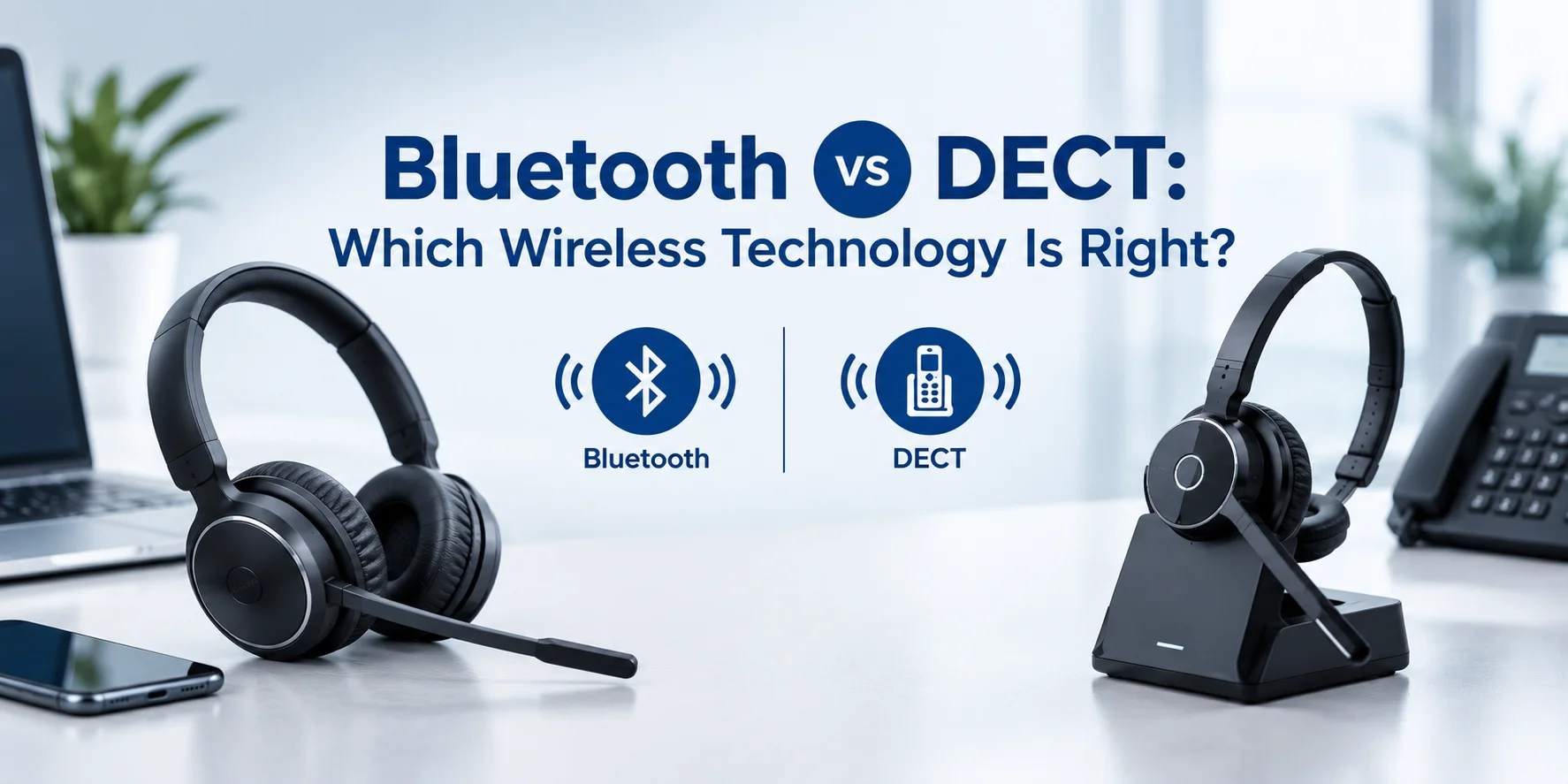
Bluetooth vs DECT: Which Wireless Technology Is Right?
Wireless is only the beginning. One of the other things to remember is how compatible headsets are with the devices you use.
Bluetooth for Flexible Device Connectivity
One possible use for Bluetooth is to pair a compatible headset with a computer, smartphone or other supported devices.
It's advisable for individuals who work on numerous gadgets or are seeking versatility between home and office.
For instance, a hybrid employee might use a laptop for video conferences and a smartphone for phone calls. Switching between supported devices may be easier with a compatible Bluetooth headset.
Be sure to read the specifications of the specific model as Bluetooth functionality and compatibility may differ.
DECT for Professional Office Mobility
The advantage of DECT is that it gives a wider wireless coverage in an office for professional wireless communication.
Employees may find it helpful when mobile and required to be connected in the workplace.
A professional communication headsets like the models in the Jabra Engage series are developed for this kind of work environment.
The easy solution is:
Mobile ability and longer wireless range might be more appropriate for DECT, while flexible connectivity between compatible devices could be more suitable for Bluetooth.
Which Jabra Headset Connection Is Best for Your Work Setup?
The best Jabra headset connection for you will depend on the type of work you do, as well as your devices. Requirements of employees can vary.
USB wired: Best for individuals who primarily use one computer and prefer a plug and play option.
Bluetooth: It is useful for those people who connect to compatible smartphones, laptops, computers and other supported devices and prefer more flexibility in their use.
DECT: It's more appropriate for an office environment where workers must move from one location to another and still have access to the rest of the office.
Wireless base system: Useful for office users seeking to connect a wireless headset to a compatible desk phone, computer or other communication device, depending on the model of the headset.
When selecting make sure you consider your work space, your devices, your mobility, and if you will be needing to connect outside of your work space.
This is useful to remove unnecessary features and make the headset more suited to your working style.
The compatibility factor is whether a Jabra Headset is compatible with your devices.
Compatibility: Will a Jabra Headset Work With Your Devices?
Support for a headset may apply to a computer, smartphone, desk phone, or communication platform but there may be variations in support based on the model. A headset that connects to one device may not be compatible with another.
When purchasing, make sure that the headset is compatible with the devices you intend to use, including:
- Windows or Mac computers
- Smartphones and tablets
- Desk phones
- USB connections
- Bluetooth
- Choose the communication or UC platform of your choice
If your business uses Teams, compatibility with Microsoft Teams is another important factor to check. Features that are provided can differ between models; some are available for Teams.
Not all Jabra wireless headsets are compatible with all devices. Please refer to the compatibility information for each model before buying.
How Do You Choose the Right Jabra Headset for Your Job?
Not every Jabra headset is necessarily the top choice. It should be as similar as possible to the way you work.
For example, a worker in one area may want to use a simple headset with wires. A portable management unit might be useful for a manager on the go. The receptionist may prefer to use a mono headset, since they might want to hear the people close to them.
Your job can help guide the choice:
| Work Situation | Suitable Option |
|---|---|
| Fixed desk work | Wired headset |
| Frequent movement | Wireless headset |
| Multiple compatible devices | Bluetooth |
| Larger office coverage | DECT |
| Need to hear people nearby | Mono |
| Need more focus on calls | Stereo |
The idea is to select the headset that's designed to meet the real work requirement and not overkill with features one might not necessarily end up using.
How Much Wireless Range Do You Actually Need?
Wireless range is most important when you're away from your desk on a call.
This will vary according to the model of the Jabra and the technology used for the wireless.
For example, the Jabra Evolve2 65 Mono boasts up to 30 m / 100 ft Bluetooth wireless technology, making it ideal for many home and office settings.
If you have an office that is larger, where staff are likely to be moving about, a DECT headset like the Jabra Engage 65 SE Stereo would be more appropriate with a range of up to 150 m / 490 ft from the base.
These are the maximum advertised ranges. This actual range may be reduced due to walls, floors, office layout, wi-fi equipment and others that can cause interference.
For short distances away from your workstation, distances of up to 30 m can be sufficient. A longer range DECT headset might be better if you work in multiple offices, departments or work areas.
The key is to select the range that you need, not just the largest headset.
Is a Wireless Jabra Headset as Good for Calls as a Wired One?
Today's business-grade wireless headsets can offer excellent audio quality. That wired headsets sound better isn't always an accurate statement.
Several factors affect call quality such as:
- Microphone performance
- Speaker quality
- Audio processing
- Connection quality
- Background noise
- The specific headset model
Also, a wireless headset can function well for team meetings, customer calls, VoIP calls and usual business communication.
If you're working at the same workstation most of the time, a wired headset might be the easier alternative.
The key thing is to pick a model that offers the call performance that you desire.
Microphone Quality Matters More Than You May Think
A business headset allows you not just to hear the other person, it lets you hear the sound of a business.
It should also be able to make your voice audible to the person you are calling.
This is particularly important for roles that require effective communication such as customer service, sales, reception, and other positions.
A good microphone will limit the influence of other sounds that may be present such as other people talking, typing, printing, etc., and office noise.
What About Noise Control?
Noise control can make the experience of the headset user and the other party more enjoyable.
Not all noise-control characteristics are alike, though. Some help to decrease the volume of the sounds you hear and others help to make your voice sound clearer, by minimizing background noise that enters the microphone.
For those working in call centers or open offices, think of both kinds of noise control.
You need to hear the caller, and for the caller to hear you.
Which Jabra Headset Is Better for Long Working Hours?
Comfort is a key factor if you're wearing a headset for extended periods of time each day.
Even if a headset is well-made, it can still be uncomfortable if it isn't comfortable to wear for extended periods of time.
Consider:
- Headset weight
- Ear cushion design
- Headband pressure
- Adjustability
- Mono or stereo design
- Overall fit
The correct one will depend on the duration of wear and your own comfort.
Stereo vs Mono: Which Wearing Style Is Better?
A stereo headset fits both ears and is useful for calls, meetings and focusing on sound.
A mono headset is a headset that attaches to one ear. This can make it simpler to listen and communicate with close individuals when you are on a call.
For instance, a receptionist might like to use a mono headset since he or she might need to talk with customers or co-workers who are close by.
For those seeking more information on the two styles, Jabra Mono vs Stereo Headsets: Which Wearing Style Is Better? describes their differences and which style to choose depending on your work environment.
The Jabra Engage 65 Mono SE is a professional mono wireless headset that allows an individual to remain alert to their surroundings.
Overall, stereo is better when you want focus and immersion and mono is better when you are frequently required to interact with those around you.
Battery Life: The Main Trade-Off With Wireless
One of the key differences between wired and wireless headsets is the battery management.
A wired headset is attached by a wire thus it does not require the same kind of battery charging. A wireless headset must have the necessary battery capacity for the working day.
There are variations in battery life for Jabra models. For instance, the Jabra Evolve2 65 Stereo offers up to 35 hours of talk time when the Busylight is off and up to 24 hours when the Busylight is on.
The Jabra Engage 65 SE offers 13 hours of talk time and can be charged up to 40% in 30 minutes.
As you can see, the battery life varies from model to model and you should always look up the exact model's specifications rather than the average one.
When purchasing a wireless headset, take into account:
1. Daily use: How will you use the headset daily?
2. Talk time: How much time do you spend on calls in your workday?
3. Charging opportunities: Is there a way to charge the headset in between sessions?
4. Re-charging time: How much time does it require to re-charge?
5. Work pattern: If the battery life was longer, would that help you to not be interrupted?
If you aren't making calls often, battery life may not be an important factor. It can be a lot more significant to employees who talk to customers for most of their shift.
What Happens If You Choose the Wrong Headset?
It is easy to select a headset that falls short of your real job requirements.
While a wired headset might get the job done in the beginning, it can be restrictive if it becomes necessary to stand up or move around frequently during a call.
However, if you work at the same workstation all day, a wireless headset may not be necessary.
The incorrect headset can cause:
- Unnecessary spending
- It is not a job that can be done on a long-term basis without discomfort.
- Limited mobility
- Charging problems
- Compatibility issues
The aim is to find the right headset for the job, rather than the lowest or highest price one can find.
Which Is Better for Call Center Employees?
A wired headset might be more suitable for a call center worker who works at a single workstation.
Agents typically remain at their desks and spend a majority of their day answering calls. In this case, wireless mobility might not be required.
Wireless headsets can be more helpful to a supervisor or employee who must move around the call floor but remain on a call.
Different types of headsets may be required for different roles in a call center.
Are Wireless Jabra Headsets Worth the Higher Price?
Wireless headsets are typically more costly than wired headsets, but it might be worth it for some individuals.
You may be paying for:
- Freedom of movement
- Wireless connectivity
- Compatibility to link with other compatible devices.
- Professional wireless coverage
- Charging solutions
- Improved work organization and work layout
- The key is whether you will reap the benefits or not.
For those who need to wear the headset for an entire day at their desk, a wired headset may prove to be a more cost effective solution.
If you're constantly shifting in and out of meetings, from the office and from workstations, you might appreciate the added flexibility of a wireless headset and be willing to pay the premium for it.
What Should Businesses Consider When Buying Headsets in Bulk?
When selecting a team of headsets, there are more factors to consider than you would with a personal headset.
Not all staff work in the same area or require the same services. There are better ways to cluster workers by their occupations.
Fixed Desk Employees
Wired headsets can be best for workers who are on the computer for long periods of the day.
Mobile Employees
Wireless headsets can be more beneficial for managers, supervisors and employees who have to move around while on a call.
Customer-Facing Employees
The reception and customer service personnel should be aware of the kind of microphone they wish to use, how they need to control the noise, and whether they need a mono or stereo microphone.
Hybrid Employees
Wireless connectivity for those who regularly use multiple compatible devices could be useful for hybrid workers.
Additionally, before placing a large order, also check:
- Device compatibility
- Communication platforms
- Wearing style
- Daily usage time
- Wireless range requirements
- Charging requirements
- Budget
- Services and warranties
With each employee's role in mind, a business can select a headset that eliminates the need to pay for features that are not used by all the employees.
Jabra Wired vs Wireless Headsets: Complete Comparison
| Feature | Jabra Wired Headset | Jabra Wireless Headset |
|---|---|---|
| Connection | Physical cable | Bluetooth or DECT, depending on model |
| Charging | Not normally required | Required |
| Movement | Limited by cable | Greater freedom |
| Setup | Simple physical connection | Wireless pairing or base setup |
| Wireless range | Not applicable | Depends on technology and model |
| Device flexibility | Depends on model | Often greater on supported models |
| Battery management | Not required | Required |
| Price | Usually lower | Usually higher |
| Fixed desk work | Excellent fit | May provide more than needed |
| Mobile work | Less convenient | Better suited |
| Call center use | Strong choice for fixed agents | Useful for mobile roles |
| Long working hours | Depends on comfort | Depends on comfort and battery |
| Best for | Desk-based users | Users who need mobility |
What Should You Check Before Replacing a Wired Headset With Wireless?
You don't have to switch to wireless only because you don't want to use a cable. First, think about what issues the new headset will address.
If changing from a wired to a wireless device:
Compatibility: Ensure the headset is compatible with your computer, smartphone, desk phone or other devices.
Wireless technology: Decide if Bluetooth technology or DECT technology is appropriate for your working environment.
Wireless range: Ensure it reaches the distance that you need to travel.
Battery life: See how long the headset will last and if the battery can be charged while working.
Wearing style: Choose either mono or stereo to suit your job.
Application environment: If the office is busy, they need a more powerful microphone and noise control.
Real mobility: If you don't move away from your desk very often, wireless could offer little additional benefit.
Each employee should be taken into account too. Wired headsets can be helpful for people who keep to a single spot while wireless can be helpful to those who are mobility.
How We Recommend a Jabra Headset
We do not consider only features when selecting a Jabra headset, we consider how the headset will be used.
The first step is to check that the devices are compatible. Then, think about the type of connectivity the user requires: wired, Bluetooth, or DECT. We also consider working hours, mobility, wireless distance, wearing style, microphone performance, comfort and budget.
This way, the headset will be appropriate for the real work setting.
Buying a headset with a lot of sophisticated options doesn't imply that it's the best one. The right model is the one that will offer features that you require without adding unnecessary cost and/or complexity.
Final Verdict: Jabra Wired vs Wireless Headsets
So, Jabra Wired v Wireless Headsets: Which is Better for Work? If you spend most of the day at your desk, you may want to consider a wired Jabra headset.
If you need to move around a lot, or want to connect with a few devices or additional flexibility, a wireless Jabra headset might be the best option. With Bluetooth it will be easier to connect to supported devices and DECT may be useful for professional wireless coverage and range.
The objective is not to select Wireless because it's newer or wired. After all, it's less expensive. Consider your devices, work environment, hours, comfort, wireless range and budget when choosing a job. You can get a Jabra headset that's just right for you, so you can work effectively and save money on features you don't need.
Need Help Choosing the Right Headset for Your Work?
When you are not sure which headset to get for your job, you can compare Wired v Wireless Headsets, Bluetooth, and DECT headsets based on your needs.
The Find Headsets team will be able to discuss the devices, working environment, mobility, wearing and communication with you. We have experts at your service who can also verify compatibility and select the headset that works best for you!
Find Headsets also stocks professional brands including Jabra, Poly, Yealink, Logitech, Sennheiser and SteelSeries. Coverages for warranties vary by brand and model, so be sure to review the product specifications before purchase.
In addition, Find Headsets provides a 30-day money-back guarantee, along with the necessary return procedure. A 60 day return policy may be available for some Plantronics products.
It also comes with a 24/7 customer service team, fast delivery, safe payment methods and easy returns.
Our objective of us is to walk you through the selection process and help you find the best headset for you, considering your needs, comfort, compatibility, warranty, etc.
Frequently Asked Questions
Is Jabra wired or wireless better for work?
Neither option is best for everyone. Wired headsets are often better for fixed desk work, while wireless headsets are more useful when you need mobility or flexible connections.
Are Jabra wireless headsets good for business calls?
Yes. Jabra offers wireless business headsets for communication. The best model depends on your devices, workplace, call time, and how much you need to move around.
Are Jabra wired headsets still worth buying?
Yes. Wired headsets can be a good choice for desk workers, call center employees, and anyone who does not want to manage battery charging.
Do Jabra wireless headsets need charging?
Yes. Wireless headsets use a battery and need to be charged. Battery life varies by model and usage.
Is Bluetooth better than DECT?
There is no single answer. Bluetooth can be useful for compatible computers and mobile devices, while DECT can be useful in professional environments where longer wireless coverage is needed.
Which Jabra headset is better for a call center?
Fixed agents may be better suited to wired headsets. Wireless headsets can be more useful for supervisors and employees who need to move around while talking.
Which is better for long calls, wired or wireless?
Both can work well for long calls. Wired headsets do not require battery charging, while wireless headsets provide more freedom of movement. Comfort, fit, weight, and overall design are important for both.
Can Jabra headsets work with Microsoft Teams?
Yes. Several Jabra business headsets support Microsoft Teams and other communication platforms. However, compatibility and features such as call control can vary by model, so check the headset specifications before buying.
How much wireless range do I need?
It depends on your job. If you only need to move a short distance, a shorter range may be enough. If you regularly move around a larger office, choose a headset and wireless technology that provide enough coverage.
Is a wireless headset worth paying more for?
Yes, if you need mobility, flexible connections, or a cable-free workspace. If you work at one desk most of the day, a wired headset may offer better value.
No comments yet. Be the first to comment!
Leave a ReplyYour email address will not be published. Required fields are marked *